
Much has been made of the lack of polish in Clint Eastwood’s late films. Consider the many jokes about American Sniper’s baby doll. The director reinforces this idea with how his reputation for often only doing one take through most of his shootings has become central to his own mythology. Clint Eastwood shoots fast and carelessly, it is often said. It is an idea that goes in the opposite direction of that other essential Eastwood as an auteur myth: Hollywood’s last classicist, heir, and caretaker of a great lost tradition. He is at the same time the last pro and a rushed amateur. None of these images are as representative as they seem, but their contradiction animates plenty of what gives his new movie Cry Macho power.
For Eastwood’s detractors, Cry Macho offers plenty of fuel. He never cared much for scenes that were there just to keep the movie going, if something is there just to serve the plot and doesn’t animate him much, it is better to toss it off without much effort until the moments that matter arrive, and the opening few minutes of this one until the former rider meets the boy he shares time with for most of the movie are very awkward, a concentrated shot of this tendency through a series of bureaucratic expository scenes. Dwight Yoakam and Fernanda Urrejola each have a couple of scenes with Eastwood in which they vomit information while barely really sharing their scenes. The insults are supposedly meant to cover for the infodump, but they only underscore how poor their drama remains. These are scenes that explain the plot (Eastwood as a former cowboy whose old boss asks him to extract his son out of Mexico to pay off an old debt) without bringing with them any engagement. They just highlight how Cry Macho has very little actual narrative preoccupations. Eastwood and the boy are technically being hunted and must hide, but beyond those opening and later closing scenes, the movie has no rush or great preoccupations with any of that. The action becomes a mere excuse for a trip to Mexico and for a 90-year-old man to share a few things with a teenager.
It is also a movie that is not worried with any notion of realism or plausibility. Cry Macho is a project to which Eastwood has been occasionally linked since the mid-1980s (he first thought of directing Robert Mitchum in the main role to put things in clear context), and despite bringing Nick Schenk (who previously wrote Gran Torino and The Mule for him) to update N. Richard Nash’s original script from the early 1980s, little or no effort was given to justify the presence of a 90-year-old man in the middle of the action. Actually, in the first of Yoakam’s expository scenes, Eastwood is fired for not doing his job at the farm as well anymore, which sets up the question of how old he is supposed to be inside the movie’s diegesis. Based on the Hollywood Writers Guild rules, Schenk’s rewrites needed to be very extensive to justify him getting on-screen credit, and I imagine his work involved writing out most of the actual action from it. Cry Macho has as many scenes with Eastwood taking naps as moments he gets involved with some confrontation.
The main consequence is that Cry Macho doesn’t seem like a movie out of Hollywood. It is a non-naturalist movie drained of incident that contemplates an old man in a foreign territory. Its images are disarming by how direct they are. A good deal of it is taken by scenes of daily actions and work with animals. Its third character with the most screen time is a rooster. To push it even further, a good portion of the film is in unsubtitled Spanish, with the boy acting as a translator between Eastwood and everyone around him. It is a movie about the importance of life’s little pleasures that tries the least mediating possible representation for them. Indeed, the movie that Cry Macho made me think of the most was Cristopher Columbus- The Enigma, which Manoel de Oliveira directed and starred in at the age of 98 in 2007. In it, the plot about Oliveira’s character’s obsession with proving Columbus was Portuguese was secondary to putting himself on screen (along with his wife, Maria Isabel), fiction nearly disappearing in a series of tasks and interactions by the Oliveira couple. Even some of the Portuguese filmmaker enthusiasts hate Columbus, its central thesis is preposterous, and the movie is more interested in those little moments than giving it much force. It is likely minor Oliveira, but it is touching in its descriptive passages. Oliveira, who was a race car driver in his youth, even gets to drive on screen as Eastwood gets to drive a horse again in Cry Macho.
Much has been written about Cry Macho as a movie for fans, and that is not exactly wrong, but that’s because its meanings are derived from his on-screen presence. Cry Macho would make no sense without Clint Eastwood, American cinema myth at 90 at the middle of its action. Early this year, Liam Neeson starred in a movie called The Marksman, directed by Robert Lorenz, Eastwood’s longtime producer and assistant, that had pretty much the same plot as Cry Macho, with Neeson as an old rancher that becomes protector of a Mexican boy hunted by the local mob. It is a more conventional action movie, but it is above all else a movie with Liam Neeson instead of Clint Eastwood, with its meaning reduced to its immediate action, just the hundredth variation on Cassavetes’ Gloria without anything standing out.
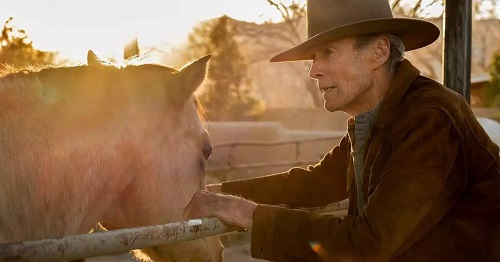
Cry Macho replaces proper events with an invitation to a dialogue about what the image projected by its star/auteur suggests; the obvious reference point would’ve been Chaplin’s Limelight. For instance, when he and the boy take refuge in a church and he remembers his dead wife and son crying, the moment exists in dialogue with a history of images, and one is invited to observe the vulnerability of the moment. Eastwood spent the first three decades of his directing career often returning to his screen image, a deconstruction that is also very narcissistic, often by way of exposing his limitations, and in this one he gets a lot out of his physical frailty. There’s only three years between Cry Macho and The Mule, but his tired body seems to have aged a lot more, and the movie, despite its lightness, gets a lot out of it and from the distance between what the writing asks for and what the body reveals.
It is the movie’s great paradox: if in all its radical stripped-down quality it is the least Hollywoodian movie out of American mainstream cinema of the past few years, its meanings are inseparable from a whole history of American popular film. Eastwood is its beginning and its end, and it is very self-conscious about being a film that could only be made by someone with enough power in the industry to allow its hollowing process to take place. It is also worth pointing out that, like, for instance, David Lynch’s The Straight Story, it happens to be a very populist film when one accepts it just doesn’t move by pre-established Hollywood rules. Those are complexities that exist throughout Eastwood’s filmography, exposed in a very direct manner.
A good part of the movie is structured the same way: the boy, usually with the rooster at hand, makes some observation reaffirming an image of masculinity (starting with the idea of calling his rooster macho), and the old man answers by trying to undercut and replace it with attempting to get closer to nature and embrace heartiness, like when he makes a point of how a cowboy’s self-sufficiency comes from cooking. It is a didactic construction that breathes because the teacher has the weight of some 65 years of roles as this idealized and celebrated action cowboy. Put Neeson in Eastwood’s place, and everything would become mechanical, but the past associations give a different weight to this self-interrogation. In a similar way, the movie’s most quoted lines—“I don’t know how to cure old” and “this macho thing is overrated”—are clear breaks of the fourth wall, less important for what they mean in the movie’s diegesis but as the filmmaker speaking openly with his audience.
Cry Macho is reminiscent of the other two movies Schenk wrote for the director, forming a kind of loose trilogy of coming to terms with the entire life and career of an artist who was allowed to keep making movies much later than most of his peers, but if Gran Torino is a final twilight for Eastwood as an icon and The Mule is a fictional confession of past sins and failures, the new film seems to use those associations with an image and a long life for a final direct address. It is a liberated movie, a rare moment in which aging is treated as a gift.
The lack of the filmmaker’s usual fatalism does take me by surprise. My two favorite Eastwoods, Honkytonk Man and A Perfect World, are also road movies with an old man playing father figure to a boy. In both, those men are presented, as happens a lot in his movies, as a kind of ghost, figures condemned to die as soon as they run out of place and don’t have more wisdom to offer. Cry Macho’s synopsis promises more of the same, but the movie takes the opposite movement, the usual damnation leaves the scene, and the old cowboy is allowed to embody his own words and live the little time he must have left. The movie doesn’t fully leave some typical Eastwoodian tics behind but offers them with an unusual tenderness. It is clear that beyond his dead family, this is a man who likes horses more than people. Filmmaker Eastwood can’t be described as a simple misanthrope, but the typical Eastwoodian character often is.
A lot of these relationships are observed through the way the movie imagines Mexico. There’s something very symbolic about it, a suspended place in direct contact with the film’s stripped-down quality, in which things are taken for what they are. Slightly idealized, the only character that registers strongly in the film beyond the old cowboy is the widow who takes them in, played by Natalia Traven, and she is there less as a character than as an idea of a quiet, well-lived existence. The movie gains in power during the action block when they stay with Traven. It is not quite an idyll because there are far too many secrets and paranoia suggesting a movie must eventually return, but it is a very specific and surprising pastoral for both its filmmaker and current American cinema. It’s interesting to note that the old cowboy and the boy aren’t just hiding, they’re working. Eastwood does all sorts of tasks to justify his safe haven at Traven’s place, tames wild horses, and, in what turns out to be the film’s most enchanting development, becomes sort of the city’s informal veterinarian. It is a very strong take on utopia and another spin on his preference for community over family. The idea of a man out of place is underlined by the constant use of translation, but the language barrier reinforces the movie’s utopian desires. If Gran Torino was a film taken by the weight of the past (Eastwood’s presence as a big return of the second half of the 20th century), and The Mule is one predicted at an absence (a man who never existed for his family becomes a man who doesn’t exist for the police), Cry Macho surprises for how well-rounded it is as this last breath of the present. Another sign that we are at a utopian suspension is that the previous film’s duality was predicted at strong racial tension, and while the weight of the border for North American imagination remains strong in the subtext, the action reduces the subject to a few observations. Speaking of symbols, the last image of what is likely the last film of the most enduring post-studio system Hollywood cinema presence is Clint Eastwood opting not to cross the border again but to allow himself to disappear not into the ghostly damnation he is used to but to return to this small-town Mexico pastoral.
 Anotacões de um Cinéfilo
Pingback: Cavalgando após Hollywood | Anotacões de um Cinéfilo
Pingback: The artist and the machine | Anotacões de um Cinéfilo